

An overview of the department, including a map of the towns and villages in the Ardèche and a complete list of the 335 local authorities.
The Ardèche: between river and mountains
The Ardèche, situated in the Auvergne-Rhône-Alpes region in south-eastern France, is a department that immediately conjures up images of breathtaking natural landscapes, picturesque villages and a rich cultural history.
This department, named after the river that flows through it, offers a mosaic of landscapes that appeal to nature lovers, history buffs and outdoor enthusiasts alike.
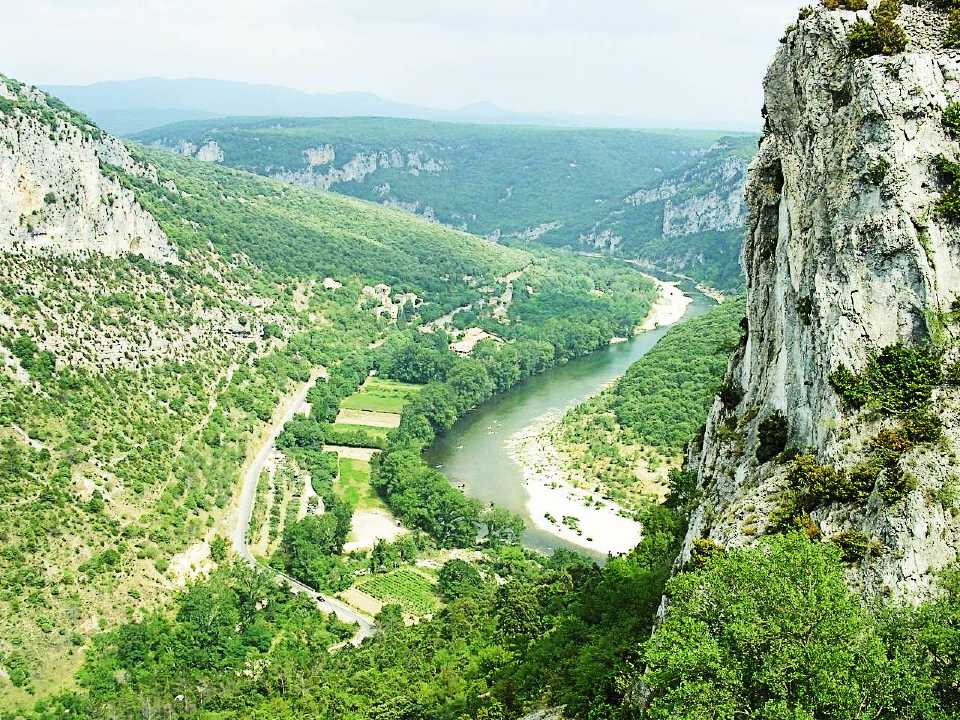
It is characterised by its geographical diversity, ranging from the Ardèche plateaus to the deep river valleys, via the famous Ardèche Gorges.
And to mark the boundary with the Drôme department, the River Rhône runs along the administrative boundary between the two departments, from north to south through the towns and villages of the Ardèche.
The Ardèche: a land of different climates
The Ardèche is divided into three main geographical areas:
- The Ardèche mountains, characterised by their high altitude and mountain climate; the mountains, offering varied landscapes with dense forests and meadows;
- The Cévennes region of the Ardèche, with its south-facing climate and vegetation influenced by the Mediterranean; also known as the Vivarais Cévennes, it is here that the Ardèche Gorges wind their way along the border with the Gard;
- The Rhône Valley is sheltered from oceanic influences by the surrounding mountains, resulting in hot, dry summers and relatively mild winters with the Mistral wind, which creates a healthy climate for both its inhabitants and the vines.
History and Heritage of the Ardèche
The history of the Ardèche is characterised by ancient human settlement, as evidenced by the numerous prehistoric sites, including the famous Chauvet Cave near the Pont d’Arc, a UNESCO World Heritage Site. This cave contains some of the oldest and best-preserved cave paintings in the world, offering an exceptional insight into prehistoric art.
The department also boasts a rich medieval heritage, with numerous castles, hilltop villages and historic sites dotted throughout the region. Villages such as Balazuc and Vogüé are listed amongst the most beautiful villages in France and offer visitors a journey back in time, to the heart of the Ardèche’s heritage.
Towns and villages in the Ardèche
At the departmental level, the Ardèche borders the River Rhône. Most of its streams and rivers are tributaries of the Rhône, flowing down from the mountains and the Ardèche section of the Cévennes through the valleys that criss-cross the region.
On the ocean side, the River Loire has its source at Mont Gerbier-de-Jonc, not far from the watershed in the Ardèche.
The department comprises 335 communes, towns and villages in the Ardèche, with a total population of 329,325 in 2020.
Here is a list of towns and villages in the Ardèche, with practical information, in alphabetical order:
Map of towns and villages in the Ardèche
To get an overview of the department, here is an interactive map of the towns and villages in Ardèche, with a link to a page containing practical information about the listed local authorities.
In addition, on this map of the Ardèche you will find:
- Natural sites and leisure activities
- transport in the department
- and other maps of the Ardèche:

Urban area, community of municipalities
And to help you explore the department further, here are some useful links, including the population census and details of the towns and communities of municipalities in the Ardèche:
- Urban areas and communities of municipalities in Ardèche (EPCI)
- Population of the Ardèche by towns and villages (2020)
Routes to the Ardèche
How to get to the Ardèche? Roads and routes to the towns, villages and attractions in the department:
Here, in the Ardèche?
Latest articles and pages published relating to the Ardèche:
- Aizac
- Lablachère in the Ardèche, a village in the Cévennes [07230]
- Lamastre, a town in the Haut-Vivarais region of the Ardèche [ 07270 ]
- Les Vans
- Mézilhac, a village in Ardèche (07530)
- Ruoms, a town in the Bas-Vivarais region of Ardèche [07120]
- Saint-Martial, a village in the Ardèche des Boutières region [ 07310 ]
- Pages and articles: Ardèche
- Accommodation and hotels in the Ardèche
- IGN maps of the Ardèche and hiking guides
- INSEE Statistics 07 ↗
- Departmental weather forecast
- Hiking in the Ardèche
- Towns and villages through which the River Rhône flows